
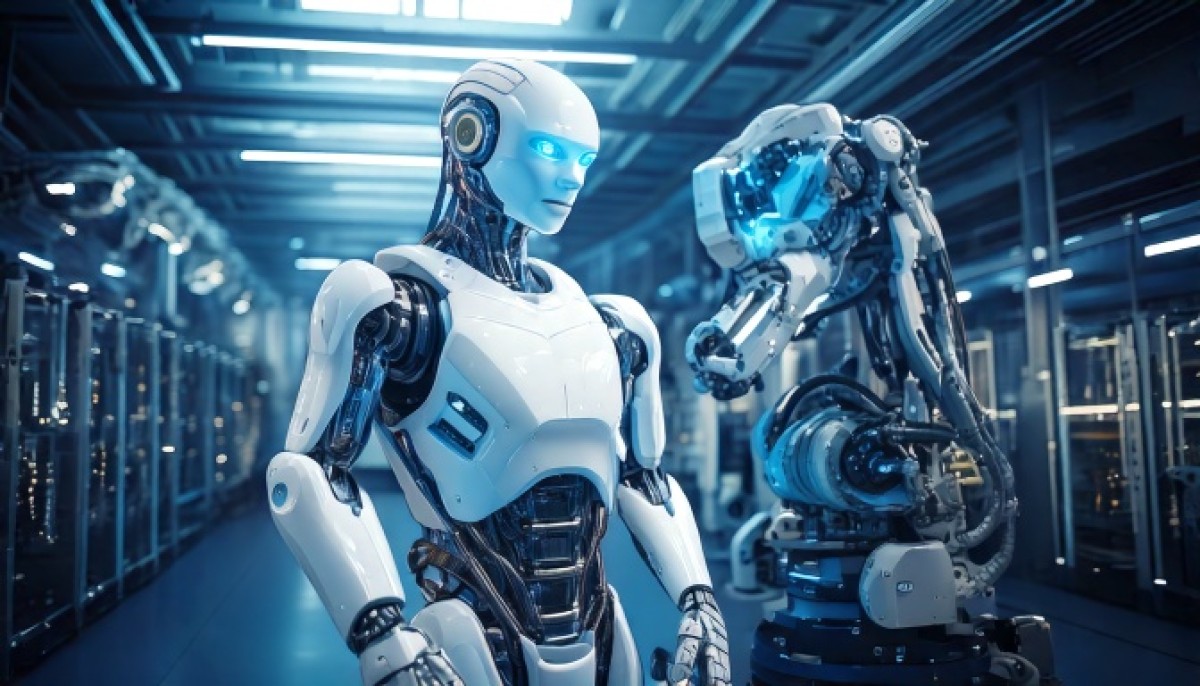
“AI robotics” sounds like a single thing, but in 2026 it’s really several very different machines arriving at once — from the robot arm welding a car to the humanoid learning to stack boxes to the little disc vacuuming your living room. Here’s a clear, hype-free tour of where AI robotics actually stands, what’s real versus oversold, and where it’s heading.
It’s the machine-by-machine companion to our pillar, how AI and robotics are quietly automating the world.
Why “AI” changed robotics
Robots have existed for decades, but old ones were essentially blind and rigid — they repeated a pre-programmed motion perfectly and couldn’t cope with anything unexpected. The AI shift gave them two new powers: perception (cameras and sensors plus AI to interpret them, so a robot can “see” and understand a scene) and adaptation (learning-based control, so it can handle variation instead of needing every move scripted). That’s the leap that turned robots from expensive single-purpose tools into flexible workers — and it’s what makes dark factories possible.
Industrial arms: the quiet workhorses
The least glamorous category is also the most economically important. Modern industrial arms are cheaper, safer around people (“cobots” designed to work alongside humans), and — thanks to machine vision — able to handle parts that aren’t in exactly the same place every time. This is the backbone of automated manufacturing and the reason factory lines keep getting darker.
Warehouse and logistics robots
This is where AI robotics scaled fastest. Fleets of autonomous mobile robots now shuttle shelves and totes around fulfillment centers; Amazon alone operates hundreds of thousands of robots across its network. The economics are compelling: predictable indoor environments, repetitive movement, and round-the-clock operation — a near-perfect fit for automation.
Humanoids: the big bet (and the biggest hype)
The flashiest category is the general-purpose humanoid robot — a machine shaped like us so it can use our tools and spaces. Companies including Tesla (Optimus), Figure, Agility Robotics (Digit), Boston Dynamics (Atlas), and Unitree are racing to build them, and early units are being trialed in warehouses and factories.
The honest read: the progress is real and faster than skeptics expected, but the demos run ahead of daily reality. A reliable, affordable humanoid that can do varied work for a full shift, safely, around people, is a genuinely hard problem. Expect steady, narrow deployments first — not a humanoid in every workplace overnight. This is the category most worth watching, and most worth taking with a grain of salt.
Consumer robots: the trend in your own home
You don’t have to visit a factory to see AI robotics — it’s already in driveways and living rooms. Robot vacuums map your floors; wire-free robot lawn mowers navigate yards using the same satellite-positioning and vision tech that guides industrial machines. Consumer robots are where most people will first feel the automation wave personally, and they’re improving every year.

The book behind this story: While You Were Sleeping
Tabitha Stowe’s gripping look at AI, automation, and the dark factories quietly replacing workers — told through the people of a town called Millhaven.
What humanoids can and can’t do today
It’s worth being precise, because this is where the hype runs hottest. Today’s best humanoids can walk, balance, recover from a shove, pick up and move objects, and perform narrow, rehearsed tasks — sorting, loading, moving totes — in controlled settings. What they mostly can’t yet do is work a full shift, reliably, at an acceptable cost, handling the constant small surprises of a real workplace without a human minding them. The gap between a polished demo and a dependable worker is exactly the “last 5% of edge cases” that has always been hardest to automate. Closing it is the whole game — and it’s a question of years, not weeks.
Why robotics is harder than AI software
If AI can write essays and pass exams, why can’t a robot reliably fold laundry? Because the physical world is unforgiving in ways software isn’t. A chatbot that’s wrong 5% of the time is annoying; a two-hundred-pound machine that’s wrong 5% of the time near people is dangerous. Software can be copied and updated instantly; robots are expensive hardware that wears out, needs maintenance, and must be safe around humans. And the real world throws endless small variations — a dropped part, an odd angle, poor lighting — that a model trained in a lab hasn’t seen. This “reality gap” is why robotics moves slower than pure software AI, and why the humanoid hype deserves patience: the intelligence is arriving faster than the dependable, affordable body to put it in.
Timeline: what to realistically expect, 2026–2030
- Right now: industrial arms, warehouse fleets, and consumer robots keep spreading and getting cheaper, while humanoids run small, supervised pilots.
- The next couple of years: “foundation models” for robots — AI trained to handle many tasks rather than one — let machines learn new jobs from data, steadily widening what a single robot can do.
- Toward the end of the decade: expect humanoids in steady commercial use for specific, structured roles, more lights-out factory lines, and automation woven quietly into daily life — rather than a sudden robot-everywhere moment.
The pattern to remember: progress in robotics is steady and compounding, not a single overnight leap — which is exactly why it’s so easy to miss until it has already arrived.
Hype vs. real: a quick scorecard
- Real now: industrial arms, warehouse AMRs, machine-vision inspection, robot vacuums and mowers.
- Real but early: humanoids in controlled pilots, AI “foundation models” that let one robot learn many tasks.
- Mostly hype (for now): the general-purpose home humanoid that does your chores; fully autonomous everything.
Where it’s heading
The near-term trajectory is more capability, lower cost, and robots that learn new tasks from data instead of hand-coding — which steadily widens the range of work they can do. That’s exactly what pushes more factory lines into the dark and brings more automation into everyday life. For what it all means for workers, read will AI and robots take your job?, and for the human story behind the machines, While You Were Sleeping is the place to go.
FAQ
What is AI robotics, simply?
Robots that use AI to perceive their surroundings and adapt, rather than blindly repeating a pre-programmed motion. That combination is what makes them flexible enough for real-world work.
Are humanoid robots actually useful yet?
They’re in early, narrow trials and improving quickly, but a reliable, affordable humanoid doing varied work all day around people is still a hard, unsolved problem. Promising — not yet everyday.
Do I already own an AI robot?
Quite possibly — a robot vacuum or a robot lawn mower uses the same core perception-and-navigation ideas as industrial robots, just scaled down for the home.
Leave a Reply