
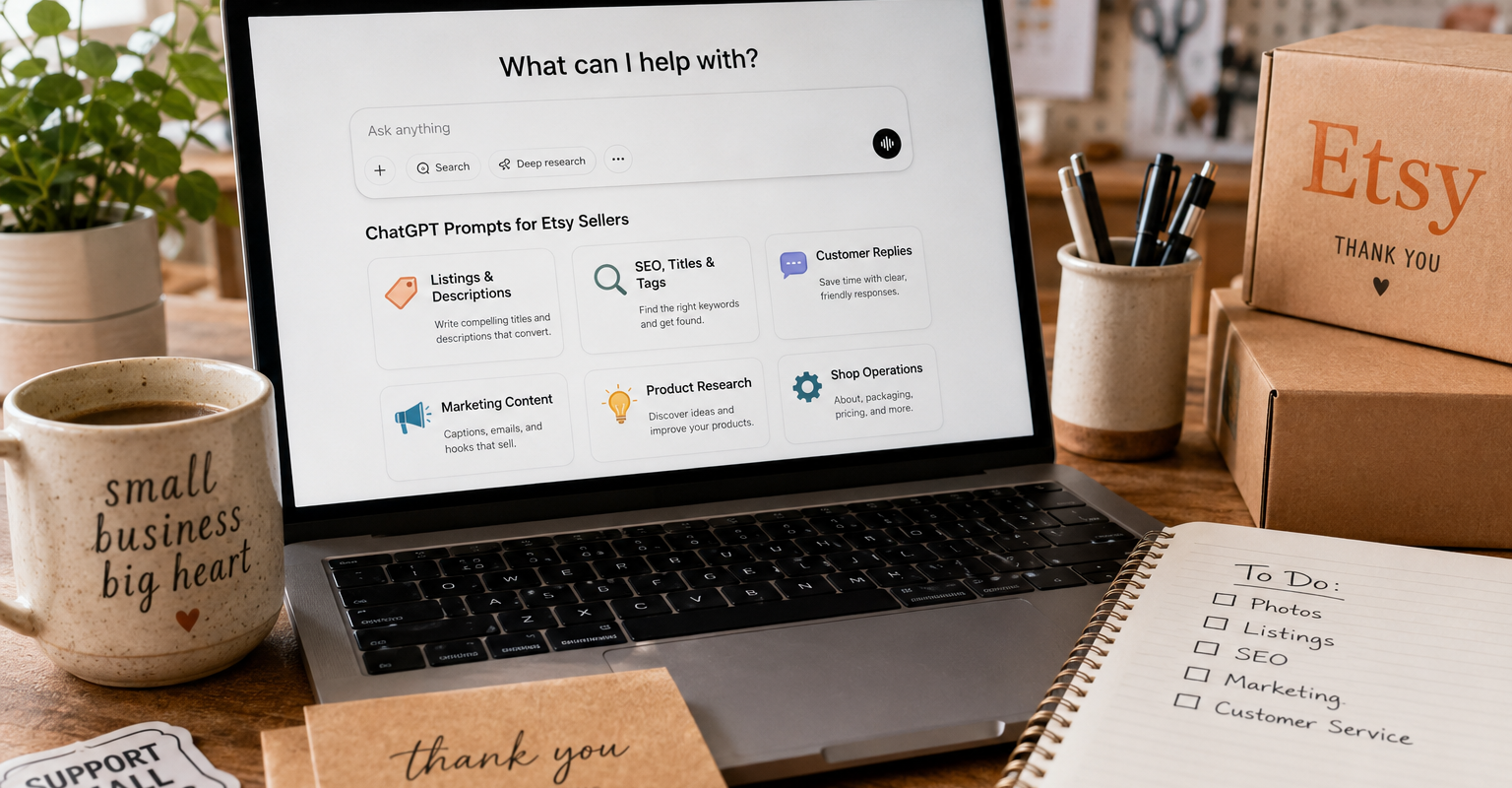
New to using AI for Etsy? This is part of The Complete Guide to Using AI for Your Etsy Shop (2026) — start there for the full workflow.
You sit down to write a listing. An hour later you have three sentences and a mild headache. ChatGPT is supposed to help, but every prompt you try spits out something that sounds like a press release for a product you’ve never heard of.
The problem is rarely ChatGPT itself. It’s the prompts. Vague input gets vague output — and most prompt advice online is genuinely vague.
This guide gives you specific, tested prompts organized by what Etsy sellers actually need to do. Use them as-is, or tweak the parts in brackets.
Why Generic Prompts Fail for Etsy
ChatGPT needs context to write well. “Write a product description for my mug” tells it almost nothing. It doesn’t know your buyer, your tone, your price point, or what makes your mug different from the 40,000 others on the platform.
Better prompts do three things:
- Name the buyer. Who is purchasing this, and why? Gift-givers and self-buyers respond to completely different language.
- Give constraints. Word count, tone, which keywords to use, what to avoid.
- Show examples or context. Paste in a review, a competitor title, or your existing description so the model has something real to work with.
Once you build that habit, the output quality jumps noticeably.
Prompts for Writing Listings and Descriptions
This is where most sellers spend the most time and feel the most stuck.
Long-form description prompt:
Write a 150-word Etsy product description for [product name]. The buyer is likely [describe buyer — e.g., “a mom shopping for a personalized gift for her daughter’s teacher”]. Tone: warm but not cutesy. Lead with the main benefit, not the materials. End with one sentence about customization options. Do not use the word “perfect.”
That last instruction matters. ChatGPT loves “perfect gift” and “perfect for any occasion.” Banning it forces better word choices.
Bullet-to-prose rewrite:
If you already have a rough bullet list of features, use this:
Here are the key details for my product: [paste your bullets]. Rewrite these as a flowing 100-word description for an Etsy listing. Keep the voice casual and direct. The buyer is [describe buyer].
Gift-buyer framing:
Rewrite this Etsy description to speak directly to someone buying this as a gift, not someone buying it for themselves. Emphasize how the recipient will feel when they open it. [Paste your existing description.]
Prompts for Etsy SEO, Titles, and Tags
Etsy SEO is specific. Titles and tags need real search phrases, not creative marketing copy. ChatGPT can generate good candidates, but you have to tell it that.
Title prompt:
Write 5 Etsy listing title options for [product name]. Each title should be under 140 characters. Lead with the highest-traffic search term, then add secondary descriptors. Do not start with the brand name. Separate phrases with commas. Avoid made-up compound words.
13-tag generator:
Generate 13 Etsy tags for [product name]. Each tag must be 20 characters or fewer. Use real phrases buyers search for, not single generic words. Focus on [main use case], [buyer type], and [occasion if relevant]. Return as a simple list.
Reverse-engineer a competitor title:
This one is useful when you’re entering a crowded category.
Here is a top-selling Etsy listing title: [paste title]. What search terms and buyer intents is this title targeting? Based on that analysis, write 3 alternative titles for my similar product: [describe your product]. Make mine distinct but targeting the same buyer intent.
Seasonal rewrite:
Take this existing Etsy listing title and rewrite it to target [holiday/season] buyers without losing the evergreen search terms. Original title: [paste title].
Prompts for Customer Service Replies
Customer messages eat time in a way that’s easy to underestimate. A good prompt here saves five to ten minutes per message and keeps your tone consistent.
Shipping delay reply:
Write a polite, brief reply to an Etsy customer asking why their order hasn’t arrived yet. The order is [X] days into a [Y]-day shipping window. Acknowledge their concern, explain without over-explaining, and tell them the next step (contact us if it doesn’t arrive by [date]). Tone: professional but human. Under 80 words.
Declining a refund request:
Write a professional Etsy reply declining a refund request. The reason for declining: [your reason — e.g., “the item was personalized and described clearly as non-refundable in our shop policies”]. Be empathetic but clear. Do not be apologetic about the policy itself. Under 100 words.
Custom order inquiry:
Write a reply to an Etsy customer asking if I can make a custom version of [product]. I [can / cannot] do this. If yes: explain the process in 2-3 steps and ask the key questions I need answered before I can quote. If no: decline warmly and suggest what I do offer instead.
Prompts for Marketing Content
Most sellers don’t need a full-time content calendar. They need a few posts that move product. These prompts are scoped for that.
Instagram caption for a product:
Write an Instagram caption for [product name]. Tone: [choose — e.g., friendly, dry, heartfelt]. Lead with a relatable observation, not the product name. Introduce the product in the second or third sentence. End with a soft call to action (link in bio). No hashtags — I’ll add those myself. Under 100 words.
Email for a product launch:
Write a short launch email for my new Etsy product: [product name and one-line description]. The email should be under 200 words. Subject line options: give me 3. Body: mention who it’s for, what problem it solves, and where to buy it. Tone: direct, no hype.
TikTok hook options:
Give me 5 opening-line hooks for a TikTok video about [product or topic]. Each hook should create curiosity or name a relatable problem. Under 15 words each. Do not start with “Have you ever.”
Prompts for Product Research
This is an underused category. ChatGPT won’t give you real sales data, but it’s solid for brainstorming adjacent products and stress-testing your lineup.
Adjacent product brainstorm:
I sell [product] on Etsy. Suggest 10 adjacent products that the same buyer might want. For each one, briefly explain why the same customer would buy it. Focus on products that could be made with [your materials or skills].
Review mining:
Copy a batch of your reviews (or competitor reviews) and run this:
Here are customer reviews for [product type] on Etsy: [paste reviews]. Identify the top 3 things buyers praise most and the top 3 concerns or complaints they mention. Then suggest 2 ways I could improve my listing or product based on this.
Prompts for Shop Operations
These are the admin tasks sellers often skip because they’re low-urgency and high-effort. A prompt drops the effort enough to actually get them done.
About section:
Write an Etsy About section for my shop. Here are the key facts: [your name, what you make, where you’re based, how long you’ve been doing this, what makes your work different]. Tone: warm, first-person, not salesy. Under 200 words. Do not use the phrase “passion for.”
Packaging insert:
Write a short thank-you note to include in my Etsy packages. It should thank the customer, give one sentence about care instructions for [product type], and encourage them to leave a review if they’re happy. Friendly tone. Under 80 words. Do not offer a discount code.
Pricing math check:
Here are my costs for [product]: materials [amount], labor at [hourly rate] for [hours], packaging [amount], Etsy fees [amount]. Suggest a retail price that gives me a healthy margin and fits within the typical range for [product type] on Etsy. Show your math.
How to Get Consistently Better Output
A few habits that improve results across all of these:
- Paste in examples. Your best existing listing, a review you loved, a competitor title. Context is everything.
- Ask for multiple options. Request 3 to 5 versions and pick the strongest parts from each.
- Tell it what not to do. “Avoid words like ‘perfect,’ ‘stunning,’ and ‘one-of-a-kind'” saves a lot of editing.
- Give it your voice. Paste two or three sentences you’ve written yourself and say: “Match this tone.”
- Iterate, don’t start over. If the first output is 70% good, paste it back and ask for targeted edits rather than regenerating from scratch.
If you want a full set of ready-to-use prompts covering listings, SEO, customer replies, marketing, and more, the 75 ChatGPT Prompts for Etsy Sellers pack from StoweLabs has 75 fill-in-the-blank prompts with sample outputs, organized by task. It’s built for sellers who already use ChatGPT but keep getting bland results.
Otherwise, the prompts above are enough to start. Pick one category, run a few, and adjust based on what comes back. Better listings don’t require more time — they require better instructions.
Leave a Reply