
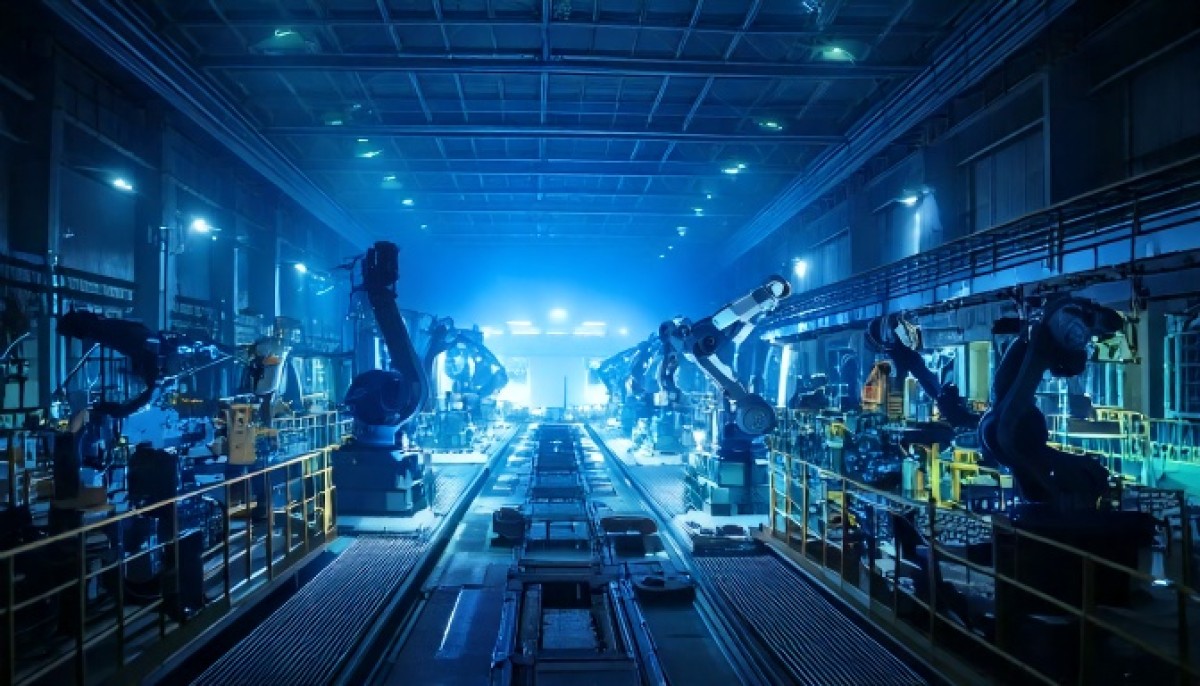
Somewhere in the world right now, a factory is running at full speed in total darkness. No overhead lights. No lunch breaks. No night shift clocking in — because there is no shift. Just robotic arms moving in the black, guided by cameras that don’t need light the way our eyes do. They call these dark factories, and they are no longer science fiction. While most of us were sleeping, automation quietly crossed a line.
This guide explains what dark factories actually are, the AI and robotics that make them possible, why they’re spreading faster in 2026 than almost anyone predicted — and, most importantly, what it means for the rest of us: the workers, the small-business owners, and the everyday people whose livelihoods sit on the other side of all that automation.
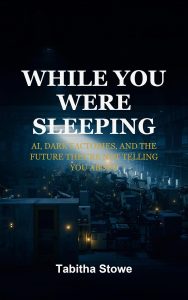
The book behind this story: While You Were Sleeping
Tabitha Stowe’s gripping look at AI, automation, and the dark factories quietly replacing workers — told through the people of a town called Millhaven.
What is a dark factory?
A dark factory — also called lights-out manufacturing — is a production facility so fully automated it can run with the lights off, because no humans need to be on the floor. Machines load the raw materials, machines run the processes, machines inspect the output, and machines move it all to the loading dock. People may still watch from a control room or come in for maintenance, but the actual making of things happens without human hands.
The name is close to literal. If nobody’s on the floor, you don’t need to light, heat, or cool the building for human comfort, so the line can run in the dark. Most real factories sit somewhere on a spectrum between “mostly people” and “mostly machines,” and a truly 100% dark plant is still rare — but the direction of travel is unmistakable. We break the definition down further in what is a dark factory.
Real dark factories aren’t a prediction — they already exist
This is the part that surprises people. Lights-out manufacturing isn’t a forecast; pieces of it have been running for years and are now scaling fast:
- Robots building robots. Japanese robotics maker FANUC has famously run parts of its operations lights-out, with robotic arms assembling other robots for long stretches with almost no one on the floor.
- Phones almost untouched by hands. Xiaomi has publicized a “dark factory” in Beijing that it says can turn out a smartphone roughly every second with very little human involvement.
- Warehouses that move themselves. Amazon now runs hundreds of thousands of mobile robots across its fulfillment network and has been testing humanoid units alongside them.
- Mass assembly, automated. Electronics giants such as Foxconn have deployed armies of robots (nicknamed “Foxbots”) to take over assembly work that once needed thousands of people.
No single one of these is a fully autonomous, human-free plant in every respect — but stitch the capabilities together and you get the blueprint for one. The technology gap between “heavily automated” and “genuinely dark” is closing quickly.
The technology behind the dark
Four advances had to mature at once for dark factories to become practical. In 2026, they finally have:
- Cheaper, more capable robot arms. Industrial robots cost a fraction of what they did a decade ago and can now handle delicate, variable tasks rather than only bolting the same part in the same spot.
- Machine vision. AI-powered cameras let a line “see” — guiding grippers, spotting defects, and adjusting on the fly — which is exactly why the lights can go off.
- AI and machine learning. Models optimize the line in real time, predict when a machine is about to fail, and let robots adapt to new products without being painstakingly reprogrammed.
- Mobile robots and digital twins. Autonomous mobile robots (AMRs) ferry materials around the floor, while a “digital twin” simulates the whole factory in software so changes can be tested before a single real part moves.
We go deeper on the machines themselves — including the humanoids now entering the picture — in AI robotics in 2026.
Why it’s accelerating right now
Automation has been creeping forward for decades. What changed is that several pressures hit at the same moment:
- The AI leap. The same breakthroughs powering chatbots also gave robots far better perception and control. A robot that can adapt is worth vastly more than one that can only repeat.
- Labor shortages and rising wages. Manufacturers in many countries simply can’t find — or afford — enough people for repetitive factory work, and a robot that works three shifts never calls in sick.
- Falling robot costs. As hardware gets cheaper and software does more of the heavy lifting, the math that once only worked for giant car plants now works for mid-sized manufacturers too.
- Reshoring and resilience. After years of supply-chain shocks, companies want production closer to home — and automation is how they make higher-wage countries cost-competitive again.
The economics: why a machine wins the math
Dark factories aren’t spreading because executives love robots; they’re spreading because the numbers finally work. A robotic line doesn’t take holidays, doesn’t need benefits or breaks, and runs three shifts back-to-back without overtime. It produces the ten-thousandth unit exactly like the first, so defect rates and waste fall. And because it can run unattended overnight and on weekends, the same expensive equipment makes far more before it’s paid off.
For decades that math only closed for the very largest manufacturers making enormous volumes — the upfront cost of automation was simply too high for anyone else. What changed is both sides of the equation moving at once: robots and sensors got cheaper while AI made them capable enough to replace more than a single bolted-on task. Cross those two lines and automation stops being a luxury for car giants and becomes the default for mid-sized factories too. That tipping point is what 2026 looks like.
A short history: automation didn’t start with AI
It helps to see dark factories as the latest step on a very old staircase, not a sudden break. The mechanical loom automated weaving and terrified hand-weavers. The assembly line broke complex work into repeatable steps a machine could eventually take over. Computer numerical control (CNC) let machines run precise programs on their own. Industrial robots automated welding and painting in car plants. Each step moved more of the “doing” from human muscle to machine.
What AI adds is the ingredient those earlier machines lacked: judgment in the moment. A loom couldn’t see a flaw; an old robot couldn’t cope with a part that shifted half an inch. AI-driven perception and adaptation remove exactly those limits — which is why the lights can finally go off. The dark factory is continuous with two centuries of history and a genuine new threshold. Both things are true, and holding them together is the only way to think clearly about what comes next.
The human question: what happens to the workers?
This is the part the press releases tend to skip. Automation has always destroyed some jobs and created others — that’s the historical pattern, and it’s genuinely reassuring on a long enough timeline. But two things about this wave feel different: the speed, and the breadth. When machines can see, adapt, and move, the roles most exposed aren’t just on the assembly line — they spread into warehousing, logistics, and beyond.
How worried should you actually be, and which jobs are most and least exposed? We lay it out honestly in will AI and robots take your job? — including the part most coverage gets wrong.
The book behind this story: While You Were Sleeping
Tabitha Stowe’s gripping look at AI, automation, and the dark factories quietly replacing workers — told through the people of a town called Millhaven.
What dark factories mean for small businesses and ordinary people
Here’s the twist worth sitting with: the same wave that automates a factory job also hands enormous power to the individual. The tools that let a corporation run a plant in the dark are, in cheaper form, the tools that let one person run a real business from a laptop — AI that writes, designs, researches, and handles customers at a scale that used to require a team.
So the story isn’t only “robots take the jobs.” It’s also “the cost of building something of your own just collapsed.” The most durable hedge against being automated out of a paycheck is owning a slice of the automation — a side business, a digital product, a shop that’s yours. That’s why we point readers toward practical starting points: the best AI tools and courses for side-hustlers, how to make money selling digital products, and using AI to run an Etsy shop. Even the friendly robots showing up in driveways — like the wire-free robot mowers we test — are the same trend arriving at consumer scale.
What they’re not telling you
The official story about automation is always smooth: more efficiency, better jobs, cheaper goods, everyone wins eventually. Some of that is true. But the pace and quietness of the shift — factories going dark while the public conversation lags years behind — is exactly the gap Tabitha Stowe set out to close. While You Were Sleeping tells the story through the people of a town called Millhaven, where the future arrives before anyone’s ready for it. If this guide unsettled you a little, that’s the point — and the book takes it the rest of the way.
Frequently asked questions
Are dark factories real or just hype?
Real — but mostly partial. Fully human-free plants are still rare; what’s common (and growing fast) is lights-out sections and heavily automated lines that need only a skeleton crew. The trend is unmistakable even if the “100% dark” ideal is still ahead.
Which countries lead in lights-out manufacturing?
The most automated manufacturing tends to cluster where robot density is highest — East Asian manufacturing powerhouses and advanced industrial economies — though reshoring is now pushing it into more places.
Will dark factories eliminate all factory jobs?
Not all — but they will keep reshaping which jobs exist. Routine, repetitive roles are most exposed; maintenance, robotics, and oversight roles grow. The honest take is in our jobs guide.
What can an ordinary person actually do about it?
Build something you own and learn to use the same AI tools the big players use. Owning a piece of the automation beats competing against it.
Leave a Reply