
Let’s be honest up front: ceramic cookware wears out faster than stainless or cast iron. The slick nonstick surface that makes it so pleasant to cook on is a coating, and coatings don’t last forever. But here’s the part most people miss — the difference between a ceramic pan that dies in eight months and one that’s still going strong after four or five years is almost entirely about how you treat it. Learning how to make ceramic cookware last isn’t complicated, and the habits below cost you nothing. They just require a little awareness at the stove and the sink.
If you’re still shopping, our Best Ceramic Cookware Sets in 2026 guide walks through which sets actually hold up. But once you own a set, care is what determines your real cost-per-year.
Cook on low to medium heat — this is the big one
If you change only one habit, make it this. High heat is the single fastest way to ruin a ceramic coating. The good news is you almost never need it. Ceramic transfers heat efficiently, so a pan set to medium does the same job that high heat does on cheaper nonstick. Blasting an empty or near-empty ceramic pan on high breaks down the coating’s structure, and once that starts you’ll see food beginning to stick where it never used to. Sear on medium, simmer on low-to-medium, and save high heat for boiling water in a separate pot. Your pan will thank you for years.
Use the right utensils — wood, silicone, or nylon only
Metal utensils scratch ceramic, full stop. A single careless scrape with a metal spatula can gouge the surface, and once the coating is breached it starts to fail outward from that spot. Stick to wood, silicone, or nylon tools. They’re cheap, they’re gentle, and they keep the cooking surface intact. While you’re at it, don’t cut food directly in the pan, and don’t use whisks or beaters against the surface.
Skip the aerosol cooking sprays
This one surprises people. Aerosol cooking sprays seem harmless, but they contain propellants and additives that leave a thin, sticky residue. Over repeated use that residue bakes onto the coating, builds up in a layer you can’t easily scrub off, and actually degrades the nonstick surface underneath. Instead, use a small amount of real oil or butter — a teaspoon is plenty. It cooks cleaner, tastes better, and doesn’t shorten your pan’s life.
Preheat gently, with a little oil
Don’t crank an empty ceramic pan to get it hot fast. An empty pan on high climbs to temperatures the coating wasn’t built to handle, and dry overheating is a coating killer. Add a little oil or butter first, then bring the pan up to temperature slowly over medium heat. The oil helps distribute heat evenly and gives you a visual cue — when it shimmers, you’re ready. Gentle preheating protects the surface and gives you better results anyway.
Hand-wash, even if it says “dishwasher safe”
Plenty of ceramic sets are labeled dishwasher safe, and technically they’ll survive a cycle. But “survive” and “last” aren’t the same thing. Dishwasher detergents are harsh and abrasive, and the high-heat drying cycle stresses the coating every single time. Hand-washing with a soft sponge, warm water, and a little dish soap is gentler and adds real life to the pan. It also takes about thirty seconds, since food rarely sticks to ceramic in the first place. Let the pan cool before washing.
Never shock it with temperature changes
Thermal shock — a sudden swing in temperature — can crack a coating or warp the pan base. The classic mistake is pulling a hot pan off the burner and running it under cold water to cool it down or to “make cleanup easier.” Don’t. The rapid contraction is rough on both the coating and the metal underneath. Let the pan cool naturally on a trivet or a cold burner before it touches water. Same logic applies to putting a hot pan straight into a cold sink or onto a cold countertop.
Store pans so they don’t scratch each other
The damage doesn’t only happen at the stove. Stacking ceramic pans directly on top of one another lets the rims and bases grind against the cooking surfaces below, and that abrasion adds up over months. Slip a felt or cloth pan protector between stacked pans — or just fold a paper towel or two and lay it inside. Hanging pans is even better if you have the space. It’s a tiny habit that prevents a surprising amount of wear.
Use oil and butter, not nothing
It’s tempting to cook fully dry on a nonstick pan to cut calories, but a thin film of oil or butter does more than prevent sticking — it acts as a buffer between your food and the coating, and it helps moderate surface temperature. You don’t need much. A light coating is enough to protect the surface and keep food releasing cleanly.
Signs it’s time to replace
Even with perfect care, ceramic coatings eventually wear. Replace the pan when you notice any of these:
- Chipping or flaking — once the coating is physically coming off, it can end up in your food and the bare base will stick badly.
- Persistent sticking that doesn’t improve even with oil and proper heat — a sign the nonstick layer has broken down.
- Visible scratches or gouges that expose the material underneath.
- Warping that leaves the pan rocking on the burner and heating unevenly.
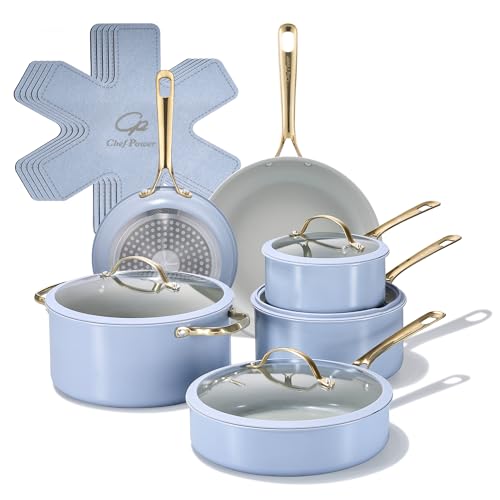
A well-treated ceramic pan can run several years; a neglected one might not make it through one. When you do replace, our current top pick is the Chef Power 15-Piece Ceramic Set, which gives you a full kitchen’s worth of pieces to apply these habits to. Treat it well from day one and you’ll get far more cooking out of it.
Affiliate note: if you buy through links here we may earn a small commission, at no extra cost to you. It never changes our picks.
Leave a Reply