
Ceramic cookware promises the best of both worlds: nonstick cooking without the chemistry that put older nonstick pans under scrutiny. But “ceramic” is a broad, loosely-policed label — it stretches from $30 sets that lose their slip in a few months to genuinely durable kits you’ll keep for years. The difference almost always comes down to three things: the quality of the coating, the construction underneath it, and how you treat the pans once they’re in your kitchen.
This guide cuts through the marketing. We’ll cover what actually matters when you buy, how many pieces you really need, how ceramic compares to nonstick and stainless steel, who should honestly skip it, and the set we’d put in our own kitchen.
Why people switch to ceramic
The number-one reason is health. Traditional nonstick is built on PTFE coatings (the material often known by the brand name Teflon), historically made with PFOA. Modern ceramic coatings are derived from sand/stone and are free of PTFE, PFOA, PFAS, lead, and cadmium — so you get easy-release cooking without those compounds. For a lot of cooks, that peace of mind is the whole pitch.
But there’s a practical reason too: ceramic releases food with very little oil or butter, which is genuinely useful if you’re cooking lighter. Eggs slide, fish doesn’t tear, and cleanup is usually a wipe rather than a scrub. Most ceramic is also oven-safe and heats evenly, and — let’s be honest — the matte, modern finishes simply look good on a stovetop.
What to look for in a ceramic cookware set
- Coating: look for a stone- or sand-derived ceramic that explicitly states it’s free of PTFE, PFOA, PFAS, lead, and cadmium. Vague “ceramic-infused” marketing is a yellow flag.
- Stovetop compatibility: induction needs a magnetic base. If you have (or might buy) an induction cooktop, confirm the set says “induction compatible” — not all ceramic sets are.
- Oven & dishwasher safe: check the oven temperature limit, and remember that “dishwasher safe” and “lasts longest in the dishwasher” aren’t the same thing (more on that below).
- Handles: riveted stainless-steel handles stay cooler on the stovetop and outlast molded plastic, which can loosen or discolor over time.
- Base construction: an aluminum core under the ceramic gives faster, more even heating and resists warping. Thicker bases sit flatter on the burner.
- Piece count: a 12–15 piece set covers a full kitchen — but read what’s counted (see the next section).
How many pieces do you actually need?
“15-piece” sounds impressive, but manufacturers count lids, and sometimes utensils, toward that number. What matters is the pots and pans. For most home cooks, three vessels do 90% of the work: a small fry pan (8″) for eggs and quick jobs, a larger fry pan (10–12″) for everyday cooking, and a saucepan (2–3 qt) for sauces, grains, and reheating. Add a stockpot or Dutch oven for soups, pasta, and batch cooking and you’re genuinely covered.
So why buy a full set? Value and consistency. A 15-piece set usually costs less per pan than buying pieces individually, everything matches, and you’re future-proofed for the cooking you don’t do yet. Just don’t pay a premium for a high piece count that’s padded with lids and a couple of nylon spoons.
Our top pick: the Chef Power 15-Piece Ceramic Set
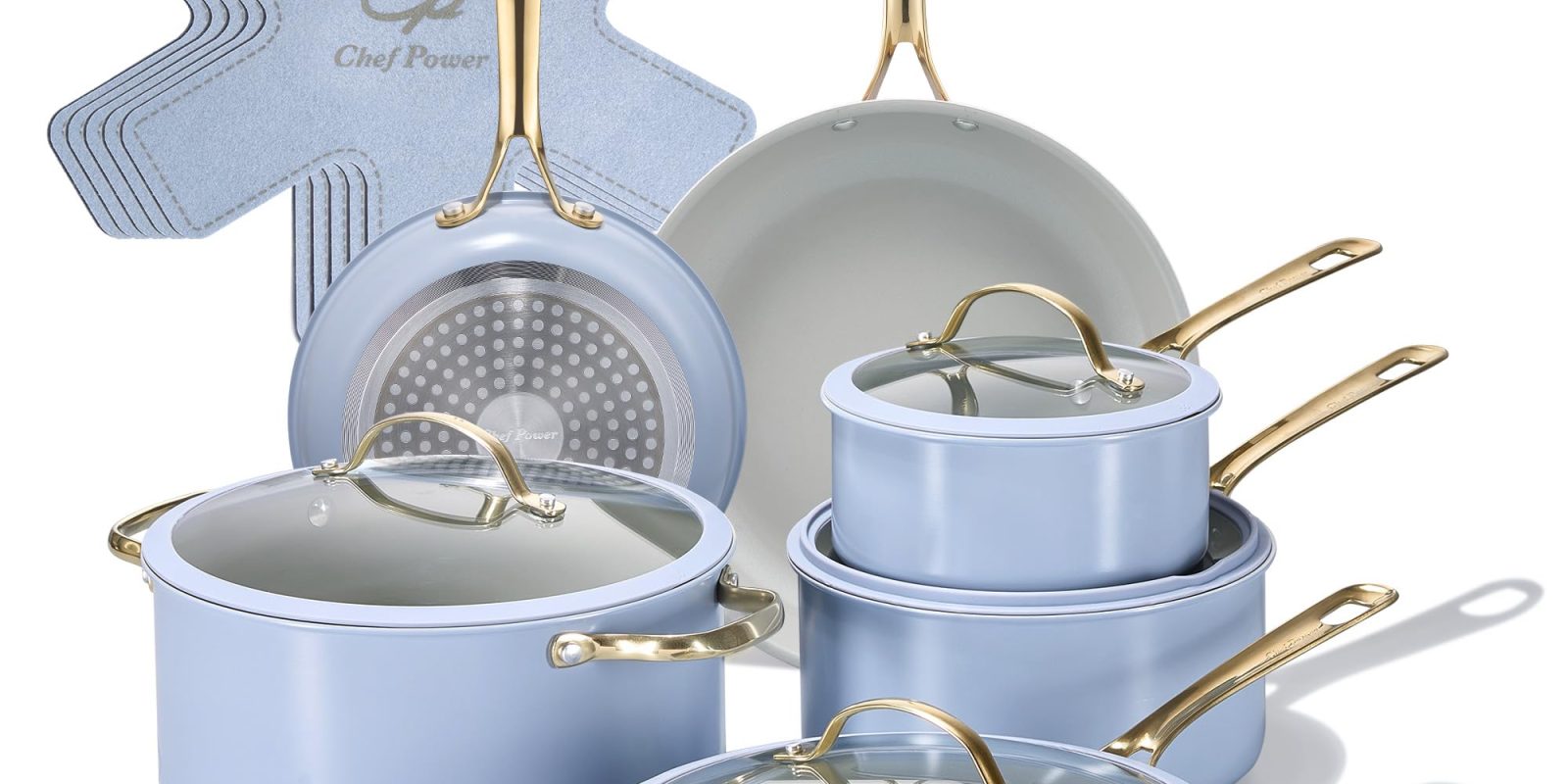
For most kitchens, we’d start with the Chef Power 15-Piece Ceramic Nonstick Cookware Set. It checks every box above: a stone-derived nonstick coating that’s free of Teflon, PFAS, PTFE, PFOA, lead, and cadmium; compatibility with induction, gas, electric, and ceramic cooktops; oven- and dishwasher-safe construction; and secure riveted stainless-steel handles. At 15 pieces it takes a kitchen from empty to fully stocked, which makes it an easy first set for a new apartment or a clean replacement for scratched-up old nonstick.
It’s the kind of set we’d recommend to someone who wants the non-toxic upgrade without overthinking it — a sensible default rather than a niche specialist. See the full breakdown and current price →
Ceramic vs. nonstick (Teflon)
This is the comparison most people are actually making. Day to day, the cooking experience is similar — both release food easily and clean up fast. The real differences are chemistry and lifespan. Ceramic skips the PTFE/PFOA coating entirely, which is the whole reason many people make the switch. The trade-off is durability: a well-made PTFE pan, treated gently, often holds its nonstick a little longer than ceramic does. If avoiding the coating chemistry matters to you, ceramic wins clearly. If you only care about maximum nonstick lifespan and you’re comfortable with PTFE, traditional nonstick still has an edge there.
Ceramic vs. stainless steel
Stainless steel is the opposite kind of tool. It’s nearly indestructible, genuinely dishwasher-proof for life, and sears meat better than any nonstick surface — but it isn’t nonstick, so eggs and delicate fish will stick without proper technique and enough fat. Ceramic is forgiving and beginner-friendly; stainless rewards skill and lasts forever. This isn’t really an either/or for a lot of cooks: the common setup is one good stainless skillet for searing and a ceramic set for everything else.
Who should honestly skip ceramic
We’d rather you buy the right thing than the popular thing. Skip ceramic if you cook on very high heat — hard searing, stir-frying in a screaming-hot wok — because high heat is exactly what shortens a ceramic coating’s life. Skip it if your priority is one pan that survives a decade of metal utensils, the dishwasher every night, and zero babying; stainless steel or cast iron will serve you far better. And be honest about how you treat cookware: if you know you’ll reach for the metal spatula and crank the burner to high, the coating won’t last, and you’ll be happier with something tougher.
Making a ceramic set last
Ceramic’s one real weakness is lifespan — but almost all of that wear is avoidable. Cook on low-to-medium heat (ceramic transfers heat well and rarely needs high), use wood, silicone, or nylon utensils instead of metal, and skip aerosol cooking sprays — they leave a thin residue that bakes on and degrades the surface. Hand-wash when you can even if the set is dishwasher-safe, avoid thermal shock (don’t run a screaming-hot pan under cold water), and store pans with felt or cloth protectors between them so they don’t scratch each other. Treated this way, a good ceramic set stays slick for years rather than months.
Frequently asked questions
Is ceramic cookware safe? Yes — quality ceramic coatings are stone-derived and free of PTFE, PFOA, PFAS, lead, and cadmium, which is exactly why many cooks switch to it.
Does ceramic cookware work on induction? Only if it has a magnetic base. Sets built for induction (like our top pick) say so explicitly; always check the listing before you buy.
Is ceramic better than Teflon? It depends on what you value. Ceramic avoids PTFE/PFOA coatings; well-cared-for Teflon often keeps its nonstick a bit longer. For most people choosing on health and ease of use, ceramic is the better pick.
Can you use metal utensils on ceramic? Don’t. Metal scratches the coating and shortens its life — stick to wood, silicone, or nylon.
How long does ceramic cookware last? With low-to-medium heat, no metal utensils, and no cooking spray, a good set holds its nonstick for several years. Abuse it and the coating can fade within a year.
Affiliate note: if you buy through links in this guide we may earn a small commission, at no extra cost to you. It never changes our picks.
Leave a Reply