
If you search for nonstick cookware reviews in 2026, you’ll find a wall of “we tested 40 pans” roundups, suspiciously perfect star ratings, and sets that all somehow claim to be the best. We’re not going to pretend we ran a lab. Instead, here’s something more useful: a clear framework for reading those reviews critically, judging any nonstick set on the criteria that actually matter, and spotting the marketing tricks that pad a spec sheet. At the end, we’ll share our own honest top pick and exactly who it’s right for.
Ceramic vs. traditional PTFE: the two coating families
Nearly every nonstick pan you’ll consider falls into one of two camps, and knowing which one you’re looking at clears up most of the confusion in nonstick cookware reviews.
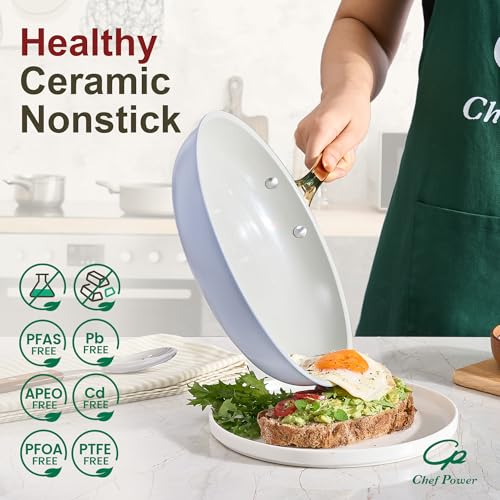
- Ceramic nonstick. A sand- or stone-derived (silica-based) coating that is naturally PTFE-, PFOA-, and PFAS-free. People choose it for the cleaner ingredient story and a slick, easy-release surface out of the box. The trade-off: ceramic coatings tend to lose their nonstick edge faster than PTFE if you abuse them, so they reward gentle care.
- Traditional PTFE (“Teflon”). The classic nonstick. Modern PTFE has been made without PFOA for years, so the old “PFOA scare” no longer applies to current pans. PTFE coatings are very slick and often last longer day-to-day, but they’re sensitive to high heat and can degrade if badly overheated.
Neither family is universally “better.” Ceramic is the pick if a PTFE/PFAS-free label matters to you; well-made PTFE is the pick if you want maximum longevity and don’t mind the chemistry. What separates a good set from a bad one is far less about the family and far more about the criteria below.
The criteria that actually matter
When you read nonstick cookware reviews, run every set through this checklist. If a review never addresses these points, it isn’t telling you enough.
- Coating type and safety labeling. Look for a specific, honest label: “ceramic, PTFE-free and PFAS-free” or “PTFE, PFOA-free.” Clear language is a good sign; vague language is a red flag (more on that below).
- Durability and expected lifespan. All nonstick coatings wear out eventually. A realistic expectation is a few years of regular use with proper care. Be skeptical of any set implying its coating lasts forever.
- Heat tolerance. Ceramic generally prefers low-to-medium heat; pushing it hot is the fastest way to dull the surface. Check the manufacturer’s stated maximum and assume you’ll mostly cook below it.
- Stovetop compatibility. This is the one people forget. Induction cooktops require a magnetic base — if your stove is induction, confirm the set is induction-compatible before buying, or it simply won’t heat.
- Oven-safe rating. If you finish dishes in the oven, look for a clearly stated oven-safe temperature, and remember that handles often have a lower limit than the pan body.
- Handle construction. Riveted, ergonomic, stay-cool handles outlast molded-on plastic. Handles are usually the first thing to loosen or fail, so they’re worth a close look.
- Piece count value. Count the pans, not the lids. A “15-piece set” sounds huge, but if half the count is lids and utensils, the real cookware value is smaller. Useful, but only if the pieces are ones you’ll actually use.
- Warranty. A meaningful warranty signals the maker stands behind durability. Read what it actually covers — coating wear is often excluded, so the fine print matters.
Marketing red flags to ignore
A surprising share of nonstick marketing is designed to sound impressive while promising nothing. Train yourself to mentally discount these:
- “Ceramic-infused” or “ceramic-reinforced.” This vague phrasing can mean a mostly-PTFE pan with a sprinkle of ceramic, or almost nothing at all. If a set is genuinely ceramic, it’ll say so plainly.
- “Scratch-proof” and “metal-utensil-safe.” No nonstick coating is truly scratch-proof. Treating any nonstick pan like it can take metal utensils forever is how coatings die early. Treat these claims as optimism, not fact.
- Padded piece counts. Counting lids, trivets, and utensils inflates the headline number. Always re-count by actual cooking vessels.
- Perfect, uniform ratings. Real cookware has trade-offs. A review that finds zero downsides is selling, not reviewing.
Caring for ceramic so it lasts
If you go ceramic, a few habits dramatically extend its life: cook on low-to-medium heat, use wood, silicone, or nylon utensils instead of metal, skip aerosol cooking sprays (they leave a residue that’s hard to remove and dulls the surface), add a little oil or butter, and hand-wash rather than relying on the dishwasher. Do that, and a good ceramic set holds its release for years instead of months.
Our honest top pick
Our recommendation for most home cooks who want the cleaner-chemistry route is the Chef Power 15-Piece Ceramic Set. It checks the boxes we care about: a plainly stated ceramic, PTFE-/PFAS-free coating, a sensible piece mix covering the pans most kitchens reach for daily, and handle construction built to last rather than molded-on plastic. It’s an honest set, not a miracle one — it asks for the same low-to-medium-heat, no-metal-utensil care any quality ceramic does, and in return it delivers reliable easy release.
Who it’s for: home cooks who want a PFAS-free everyday set, are happy to cook gently and hand-wash, and would rather buy one coordinated set than piece things together. Who should look elsewhere: anyone who routinely cranks the heat for hard searing, insists on metal utensils, or specifically wants the longest-lasting PTFE option — those cooks may be happier with a different style of pan entirely. As always, confirm induction compatibility against your own cooktop before you buy.
That’s the short version of how to read nonstick cookware reviews without getting played. For the full breakdown — including how the leading ceramic sets stack up and a deeper buying walkthrough — see our pillar guide, Best Ceramic Cookware Sets in 2026.
Affiliate note: if you buy through links here we may earn a small commission, at no extra cost to you. It never changes our picks.
Leave a Reply