
If you’re standing in the cookware aisle (or scrolling a product page) trying to settle the ceramic vs teflon cookware question, you’re really asking two things at once: which one is safer, and which one cooks better. The honest answer is that they’re closer cousins than the marketing suggests, and the “right” pick depends a lot on what you personally care about most. Let’s walk through what each coating actually is, sort the safety claims from the scare tactics, and land on a verdict you can actually use.
What each coating actually is
The two pans look similar in a drawer, but the slick surface comes from very different chemistry.
- Ceramic nonstick isn’t solid pottery. It’s a thin coating, typically derived from sand and stone (silica-based sol-gel), sprayed and cured onto an aluminum or steel body. The selling point is what it leaves out: quality ceramic coatings are free of PTFE, PFOA, PFAS, lead, and cadmium.
- Traditional nonstick is polytetrafluoroethylene (PTFE), the material most people know by the brand name Teflon. It’s a fluoropolymer that’s been the gold standard for “nothing sticks” cooking for decades.
So the core difference is simple: ceramic skips fluoropolymer chemistry entirely, while Teflon-style pans are built on it.
The safety question, answered honestly
This is where the conversation usually goes sideways, so let’s be precise. The chemical that earned nonstick its bad reputation was PFOA — a processing aid once used to manufacture PTFE. PFOA is genuinely concerning, and it was phased out of US nonstick production around 2013–2015. A pan made in the last several years generally was not made with it.
“PFAS” is the broader umbrella term — a large family of “forever chemicals” that resist breaking down in the environment and the body. PTFE itself is technically a member of that family, which is the heart of why some buyers prefer to avoid it on principle, even though the finished, intact coating is considered stable at normal cooking temperatures. Ceramic’s appeal is that it sidesteps that whole category.
A few things worth keeping straight:
- The real-world risk with any nonstick pan is overheating an empty one. PTFE can begin to break down and release fumes at high temperatures, so never preheat a nonstick pan dry and screaming hot.
- A chipped or flaking coating — ceramic or PTFE — is your signal to retire the pan. You don’t want loose flecks in your food.
- For peace of mind, “no fluoropolymers at all” is a fair reason to choose ceramic. Just don’t let anyone convince you a modern, well-treated PTFE pan is a hazard in normal use.
Cooking performance: closer than you’d think
Here’s the part that surprises people: in day-to-day cooking, both release food beautifully. Eggs slide, pancakes flip, fish doesn’t weld itself to the surface. Neither one is built for high-heat searing — that’s a job for stainless steel or cast iron. Both nonstick types are happiest at low to medium heat, which is exactly where eggs, crepes, delicate fish, and gentle sautés live.
If there’s a nuance, it’s that some cooks find ceramic runs a touch hotter and can scorch a little faster if you’re heavy-handed with the dial. Keep the flame moderate and you’ll get clean, easy release from either. For a deeper breakdown of what to look for across full sets, our Best Ceramic Cookware Sets in 2026 guide goes pan by pan.
Durability and lifespan: the real trade-off
This is where the two diverge most, and where you should set expectations honestly. Ceramic’s nonstick generally wears faster. A well-cared-for PTFE pan often holds its slickness a bit longer — that’s just the nature of the material. Most ceramic sets start to lose their effortless release sooner, especially if they’re pushed with high heat or scrubbed hard.
So why does anyone choose ceramic, knowing that? Because the appeal was never “lasts forever” — it’s skipping the coating chemistry altogether. You’re trading a little longevity for a pan made without fluoropolymers. That’s a values call as much as a performance one, and it’s a perfectly reasonable trade for a lot of households.
The good news is that careful use closes the gap. To get the most life out of either coating:
- Cook on low to medium heat — high heat is the fastest way to kill any nonstick surface.
- Use wood, silicone, or nylon utensils; metal tools scratch the coating and shorten its life. (PTFE is a little more scratch-tolerant than ceramic, but neither loves a metal whisk.)
- Skip aerosol cooking sprays. They leave a sticky, hard-to-remove residue that builds up and degrades nonstick performance. A thin film of oil or butter is kinder.
- Let pans cool before washing, and hand-wash when you can even if the label says dishwasher-safe.
- Replace any pan once the coating chips, flakes, or stops releasing — that’s the end of its useful, safe life.
So which should you pick?
There’s no single winner here, only the right fit for what you value. Break it down honestly:
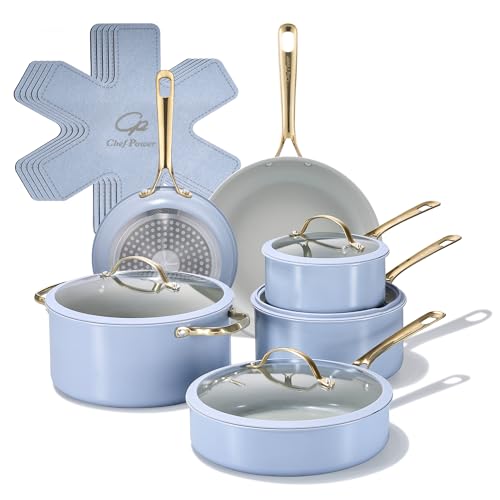
- If health and avoiding fluoropolymers comes first → go ceramic. You get easy release with a coating that’s free of PTFE, PFOA, PFAS, lead, and cadmium. Accept that you may replace it a bit sooner, and treat it gently. A well-built option like the Chef Power 15-Piece Ceramic Set covers most of a kitchen without the coating chemistry.
- If maximum nonstick lifespan is the priority → a quality PTFE pan makes sense. Modern (post-PFOA) Teflon-style nonstick holds its slickness longer and shrugs off the occasional scratch better — just don’t overheat it empty.
- Cooking with induction? Either coating works, but the pan needs a magnetic base to heat at all. Check that the manufacturer lists induction compatibility before you buy.
Whichever side you land on, the same habits decide how long your pan lasts: moderate heat, soft utensils, no spray cans, and a willingness to retire it the moment the surface gives out. Get that right and both ceramic and Teflon will serve you well — the choice really does come down to whether you’d rather have a coating that skips the chemistry, or one that hangs onto its nonstick a little longer.
Affiliate note: if you buy through links here we may earn a small commission, at no extra cost to you. It never changes our picks.
Leave a Reply